Moonrise and Moonset: How to Find Them and Why Some Days Have None
Unlike sunrise, moonrise wanders all over the clock. Here is how to look it up, what the numbers mean, and why a dash in the moonrise column is not a mistake.
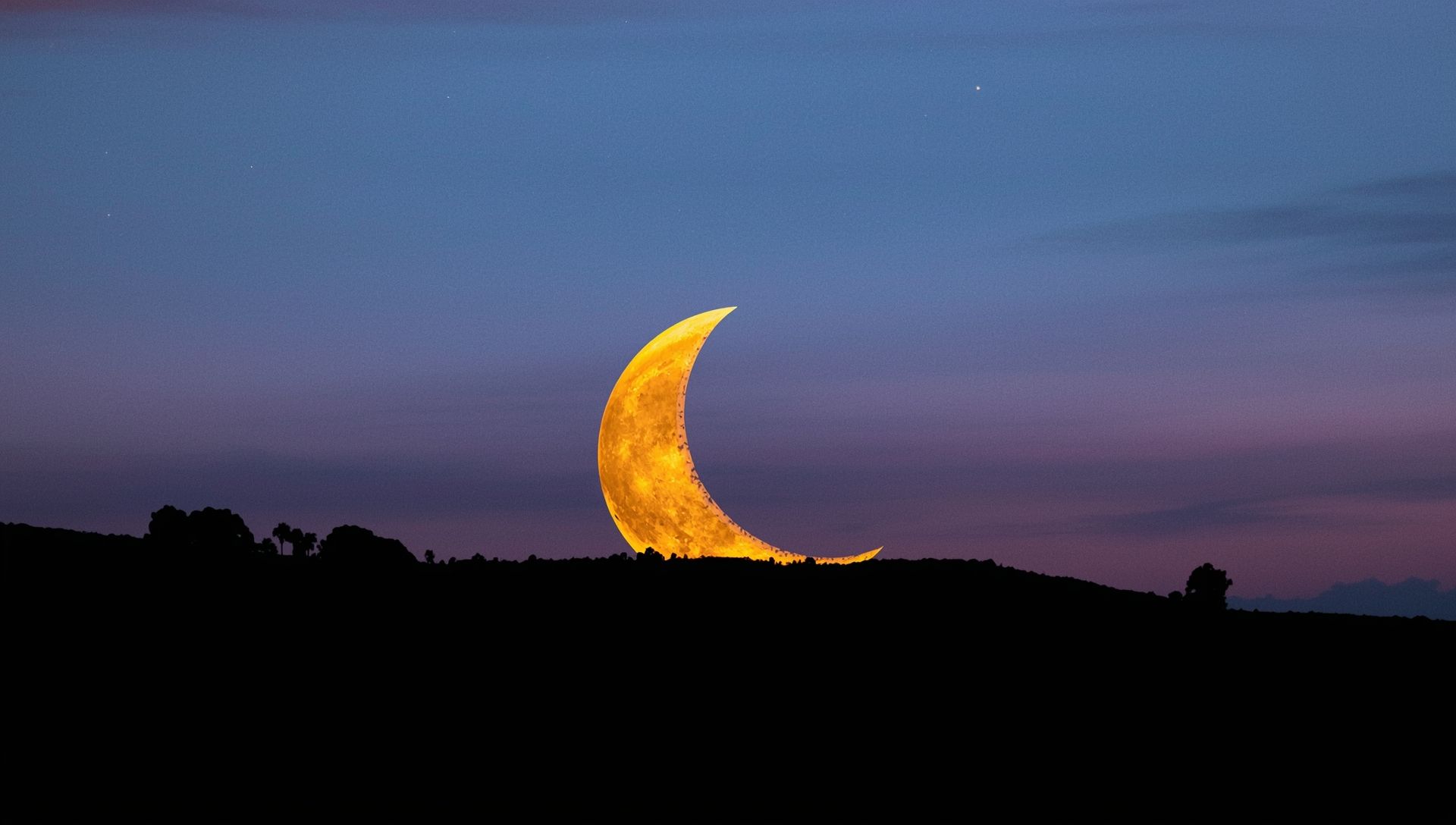
To find moonrise and moonset times, look them up for your exact location and date, because they change by roughly 50 minutes a day and differ from city to city. On SunriseAlmanac, every city has a moon page with today's moonrise, moonset, phase, and illumination. A blank or dash in the moonrise column simply means the moon does not rise on that calendar day; it rose late the day before and rises again just after midnight the next day.
That last point catches a lot of people out, so it gets its own section below.
What moonrise and moonset actually mean
Moonrise is the moment the moon's upper edge appears on an ideal, flat horizon; moonset is when the upper edge disappears. Calculations account for atmospheric refraction, which lifts the moon's image slightly, and for the moon's parallax, which matters far more for the moon than for the sun because the moon is so close.
"Ideal horizon" is the important caveat. Hills, buildings, and trees can delay what you see by many minutes. In mountain valleys, the moon may clear the ridge half an hour or more after the official time.
How to find moonrise and moonset for your city
- Open your city's moon page. For example, New York City moon times or moonrise in Brisbane. Each shows today's events in local time.
- Check the date carefully. A moonset listed at 3:12 a.m. belongs to the early morning of that date, meaning it is the end of the previous night's moon.
- Note the phase. A full moon rises near sunset; a last quarter moon rises around midnight; a new moon rises and sets with the sun and is invisible. Our moon phases guide lists typical rising times by phase.
- Plan the month. The 2027 moon phase calendar shows where each phase falls so you can pick the right week.
Reading a moonrise table
Here is a real five-day stretch for New York City from our calculator, around the last quarter moon of November 2026 (clocks went back to EST on 1 November).
| Date | Moonrise | Moonset | Illumination |
|---|---|---|---|
| 31 Oct | 10:58 p.m. EDT | 1:29 p.m. | 63% |
| 1 Nov | 11:13 p.m. EST | 1:07 p.m. | 52% |
| 2 Nov | — | 1:37 p.m. | 41% |
| 3 Nov | 12:26 a.m. EST | 2:02 p.m. | 30% |
Two things stand out. First, moonset comes before moonrise on each date: the moon that sets at 1:07 p.m. on 1 November rose the previous night. Each row is a calendar day, not a single moon "session." Second, 2 November has no moonrise. The moon rose at 11:13 p.m. on 1 November and next rose at 12:26 a.m. on 3 November, skipping the whole of 2 November.
Why some days have no moonrise (or moonset)
The interval between one moonrise and the next averages about 24 hours and 50 minutes. Because it is longer than a calendar day, moonrise steps later around the clock. Roughly once per lunar cycle, it steps over midnight and a date gets skipped. The same happens to moonset at a different point in the month.
Examples from our 2026 calculations for New York:
- No moonrise on 5 June 2026. The waning gibbous moon rose just before midnight on 4 June and next rose at 12:24 a.m. on 6 June.
- No moonset on 18 November 2026. The waxing moon set at 11:55 p.m. on 17 November and did not set again until after midnight on the 19th.
- No moonrise on 2 November 2026, as in the table above.
Nothing unusual is happening in the sky on those dates. It is an accounting quirk of mapping a 24.8-hour cycle onto a 24-hour calendar.
Polar exceptions
At high latitudes, a missing moonrise can be literal. In places such as Fairbanks or Iqaluit, the moon can stay above the horizon for more than a full day, or below it for more than a day, at certain points in the month. Check Fairbanks moon times to see it in action.
Where the moon rises on the horizon
The moon's rising direction changes through the month far more quickly than the sun's changes through the year. Over about two weeks it swings from rising well north of east to well south of east, and back again. A rough guide for mid-northern latitudes:
- Winter full moons rise north of east and climb high, opposite a sun that sets in the southwest.
- Summer full moons rise south of east and stay low all night.
- Around the equinoxes, full moons rise close to due east.
In the Southern Hemisphere the pattern is mirrored. For photography, direction matters as much as time; our moonrise photography guide goes into planning it.
Practical tips
- Add time for terrain. If your eastern view has hills or buildings, expect to see the moon several minutes to half an hour after the listed moonrise.
- Daytime moons are normal. Around first and last quarter the moon is up for much of the day. A waning moon in a morning sky is not an error in the table.
- Watch the date line in your head. An early-morning moonset belongs to the night before, so if you are planning a night outing, look at the next day's row too.
Frequently asked questions
Why is moonrise at a different time every day?
The moon moves about 12 degrees east around Earth each day, so Earth has to spin an extra 50 minutes or so, on average, to bring it back to your horizon.
What does it mean when there is no moonrise listed?
The moon rose late the previous evening and rises again just after midnight the following day, so no moonrise falls within that calendar date.
Are moonrise times the same across a time zone?
No. They depend on your exact latitude and longitude. Cities at opposite ends of a time zone can see moonrise more than half an hour apart, so always look up your own location.