Daylight in Seattle vs Miami: How Latitude Shapes Your Days
Seattle and Miami sit 22 degrees of latitude apart. That gap gives Seattle long summer evenings and short winter days, while Miami's daylight barely changes.
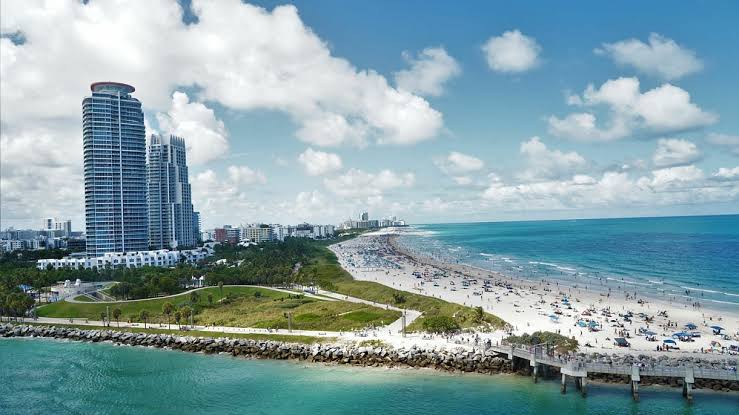
Seattle gets far more daylight than Miami in summer and far less in winter. On June 21, 2026, Seattle has 15h 59m of daylight against Miami's 13h 45m, a difference of 2h 14m. On December 21, the gap reverses: Miami has 10h 31m and Seattle only 8h 25m. At the equinoxes the two cities are nearly identical, both close to 12 hours.
The reason is latitude. Seattle sits at 47.6 degrees north, Miami at 25.8 degrees north. The farther a place is from the equator, the more its day length swings between summer and winter.
The numbers side by side
These figures are for each city on each date in 2026, computed with our calculator and rounded to the minute. Seattle times are Pacific, Miami times Eastern.
| Date | Seattle sunrise / sunset | Seattle daylight | Miami sunrise / sunset | Miami daylight |
|---|---|---|---|---|
| March 20 | 7:11 AM / 7:22 PM | 12h 10m | 7:24 AM / 7:32 PM | 12h 7m |
| June 21 | 5:11 AM / 9:10 PM | 15h 59m | 6:30 AM / 8:15 PM | 13h 45m |
| September 23 | 6:57 AM / 7:04 PM | 12h 6m | 7:09 AM / 7:15 PM | 12h 6m |
| December 21 | 7:54 AM / 4:20 PM | 8h 25m | 7:03 AM / 5:34 PM | 10h 31m |
Over the year, Seattle's day length swings by 7h 34m between the solstices. Miami's swings by just 3h 14m. Track each city day by day on the Seattle 2026 sunrise calendar and the Miami 2027 sunrise calendar.
Why latitude makes such a difference
Earth's tilted axis means that for half the year the Northern Hemisphere leans toward the sun. In June, the sun's daily path across the sky is shifted north, so it rises well north of east and sets well north of west. At higher latitudes, a larger share of that path is above the horizon, which is why Seattle's June days are so long. In December the path shifts south, and at higher latitudes a larger share of it is below the horizon.
Near the equator, the sun's path cuts the horizon almost vertically, so shifting it north or south barely changes how long it spends above the horizon. Miami is close enough to the tropics that its days stay within a narrow band. The full picture is in our guide to how day length changes through the year.
The height of the sun
Latitude also controls how high the sun climbs. At solar noon on June 21, 2026, the sun stands 87.7 degrees above the horizon in Miami, almost directly overhead, and 65.8 degrees in Seattle. On December 21, it reaches 40.8 degrees in Miami but only 19 degrees in Seattle. A low winter sun delivers weaker light and much longer shadows, which is one reason Pacific Northwest winters feel so dim even on clear days.
Twilight and golden hour
At higher latitudes the sun sinks at a shallower angle, so twilight and golden hour last longer. On June 21, 2026:
- Seattle: civil twilight ends at 9:51 PM and astronomical twilight at 12:19 AM, more than three hours after sunset.
- Miami: civil twilight ends at 8:41 PM and astronomical twilight at 9:45 PM, about an hour and a half after sunset.
Golden hour shows the same pattern. Seattle's evening golden hour on the solstice runs 73 minutes, from 8:22 PM to 9:35 PM; Miami's runs 50 minutes, from 7:41 PM to 8:31 PM. In winter Seattle's lasts 75 minutes. Compare the two on the Seattle golden hour page and the Miami golden hour page, and read our golden hour explainer for the definition.
What it feels like to live there
Seattle
Summer in Seattle brings sunsets after 9 PM for about six weeks around the solstice and a sky that stays light long after. It is ideal for evening hikes in the Cascades or kayaking on Lake Union. Winter is the trade-off: sunset at 4:20 PM in late December, and many commuters travel both ways in darkness or twilight. Cloud cover makes it feel darker still.
Miami
Miami's daylight is steady. Sunset never comes earlier than about 5:30 PM, and it never comes later than about 8:15 PM. Twilight is brief, so darkness arrives quickly after sunset year round. The midday sun is intense for much of the year, which matters for sun protection and outdoor activity timing.
Planning your days in each city
If you split time between the two cities, or are thinking of moving, the practical differences are easy to plan around. In Seattle, summer evening activities can run very late: on June 21, 2026, there is enough light for a walk until civil twilight ends at 9:51 PM. In December the same walk has to finish by about 4:56 PM. Miami barely changes: civil twilight ends at 8:41 PM on June 21 and 6:00 PM on December 21. Photographers in Seattle get longer, softer golden hours but far fewer clear days in winter, while Miami offers reliable but brief evening light all year. Gardeners notice the difference too, because many plants time their growth and flowering to day length, and Seattle's swing is more than twice Miami's.
Other US cities on the spectrum
Most of the US sits between these two. Denver and Philadelphia, near 40 degrees, fall roughly midway. Minneapolis and Portland, Oregon, are closer to Seattle's pattern. Honolulu, at 21 degrees, has an even narrower range than Miami. And Alaska goes to the extreme: in Fairbanks, the June 21 day lasts 21h 50m, which we cover in our article on the midnight sun. Every one of these cities has its own page on SunriseAlmanac.
Frequently asked questions
Does Seattle get more daylight than Miami over a whole year?
Over a full year the totals are very similar. Seattle's long summer days roughly balance its short winter days. The difference is in how the daylight is distributed, not the annual total.
Why are equinox days slightly over 12 hours in both cities?
Sunrise and sunset are timed to the top edge of the sun and include atmospheric refraction, which adds a few minutes. See why sunrise uses the top edge of the sun.
When is sunset earliest in Seattle?
In early to mid-December, about a week or two before the solstice. On December 21, 2026, it is 4:20 PM PST.